The rise, fall and rebirth of Parma
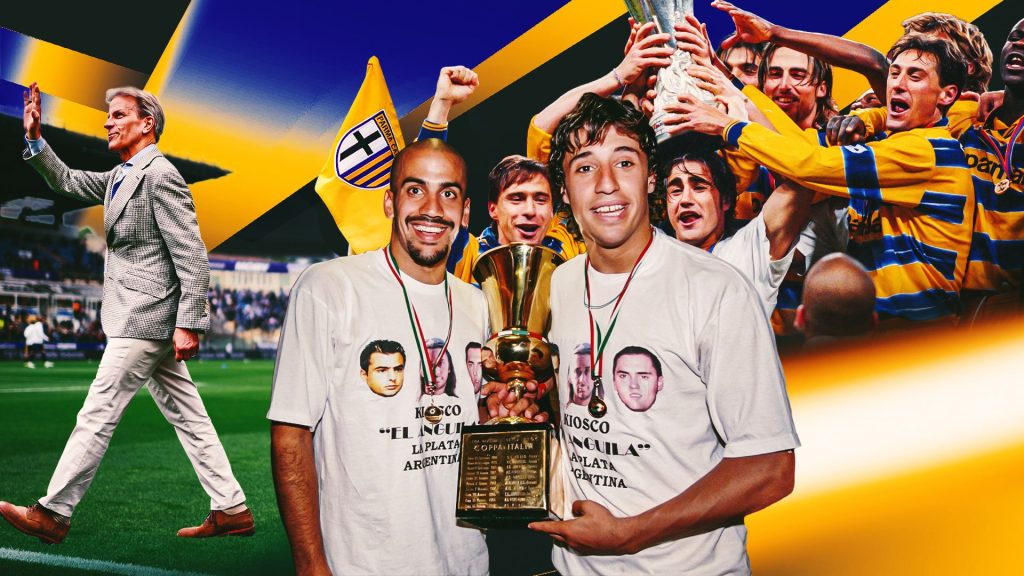
On the evening of May 12, 1999, before a crowd of 61,000 people at Moscow’s Luzhniki Stadium, Parma beat Marseille 3-0 in the final of the UEFA Cup. The game was as one-sided as the scoreline suggests – and nobody was in the least bit surprised. Parma may have been little more than a proud provincial club for almost the entirety of their existence but, by that particular point in time, they had established themselves as one of the ‘seven sisters’ of Serie A.
With their iconic yellow-and-blue striped shirts, stellar squad and scintillating style of play, the Emiliani had achieved worldwide recognition. In that sense, their success mirrored that of their owners, Parmalat, the local dairy producer that had become a global brand, and thanks to the fervent support of the company’s founder, Calisto Tanzi, Parma had gone from struggling in Serie B to excelling in Europe in less than a decade.
When Tanzi had acquired his hometown club in 1990, his twin objectives were to position his beloved Parma among the game’s elite, while at the same time enhancing his reputation as a brilliant businessman. Moscow, thus, felt like the realisation of those two goals, but Parma’s ecstatic supporters also had every reason to believe that the best was yet to come.
The Gialloblu backline boasted Gigi Buffon, Fabio Cannavaro and Lilian Thuram, Juan Sebastian Veron was running the show in midfield, while Hernan Crespo and Enrico Chiesa were tormenting defenders up front. In Alberto Malesani, meanwhile, Parma possessed one of the game’s most progressive coaches, an exponent of ‘The Beautiful Game’, as so thrillingly underlined by the Gialloblu’s third and final goal at the Luzhniki, where Chiesa thumped the ball into the top corner after Crespo had ingeniously stepped over a cross from Veron.
“It was a fantastic goal, one you’d never stop watching,” Malesani told the Gazzetta di Parma last year. “I’m proud of it, because it was the essence of football. I call it that because, in that final, I think all the elements necessary for a team to win an international competition were condensed.
“That team could have won everything: they needed to maintain the core and bring in at least a couple more champions who could ensure a leap in quality.” Parma instead suffered a dramatic decline, with the club declared bankrupt, twice, in the 16 years that followed that momentous match in Moscow.
Here, GOAL recounts the remarkable rise, fall and rebirth of Parma…