Luis Enrique’s rebuild from Galacticos to homegrown stars to Champions League kings
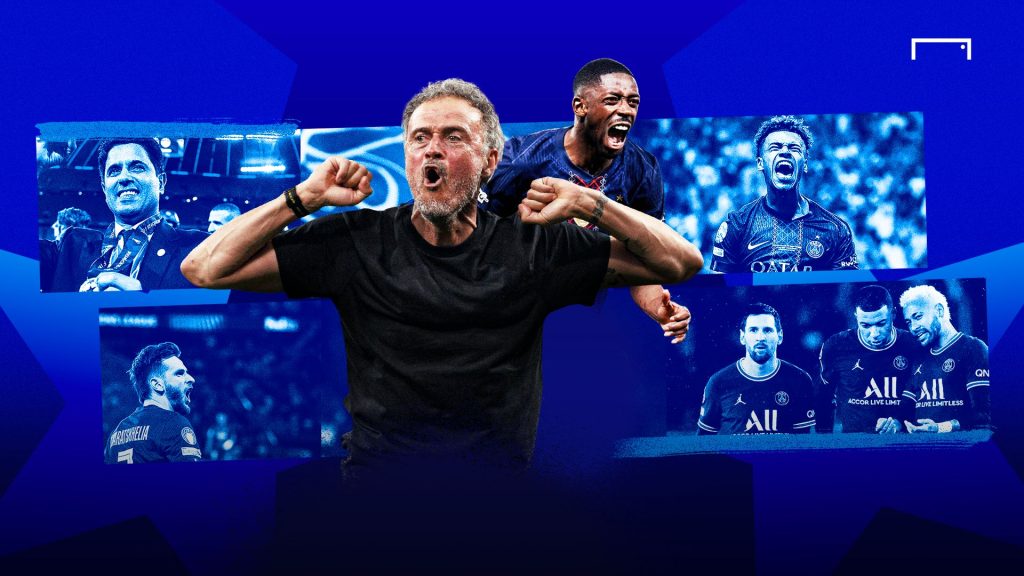
It was a heartbreaking end to their first Champions League final appearance, but a sign that European glory was achievable.
PSG looked up for the fight again the following season. They overpowered Messi’s Barcelona 5-2 on aggregate in the last-16 and got revenge against Bayern in the quarter-finals. Yet again they hit the ceiling when they were crushed 4-1 on aggregate by fellow new-money upstarts Manchester City in the last four. Embarrassingly, PSG lost their hold on the Ligue 1 title that season as Lille finished top.
The humiliation was unacceptable. The Parc des Princes team needed a major lift, and that summer offered the opportunity of a lifetime: Messi became available amid Barcelona’s financial crisis. PSG swooped in and once again all connected to the club dared to dream.
“The club and its vision are in perfect harmony with my ambitions,” Messi said. “I am determined to build, alongside [the players and staff], something great for the club and for the fans,”.
Al-Khelaifi added: “He did not hide his desire to continue to evolve at the highest level and to win trophies. The ambition of the club is of course identical. The addition of Leo to our world-class team confirms the relevance and success of our recruitment. Together with our great coach and his staff, I look forward to seeing our team make history for all of our supporters around the world.”
Former PSG president Michel Denisot called the Argentine’s arrival “the pinnacle” of the club’s history and “an immense joy for all generations of fans, players and management.” Rival Ligue 1 presidents spoke out in favour of the boost his signing would provide French football. Jean-Michel Aulas, Lyon president at the time, said: “We are all delighted… even if it makes the competition even more difficult for us.”
Reims president Jean-Pierre Caillot said: “After everything that we have experienced in recent years, a bit of lovelessness had started to creep in. We needed Messi, and he is here!”
PSG had what Denisot called a Harlem Globetrotters-esque attack, and the footballing world anticipated something mind-blowing as Messi reunited with fellow Barcelona trailblazer Neymar and partnered up with the rapid and clinical Mbappe.
For some on the inside, though, the project was doomed from the start. According to Rafinha, who left Barcelona for PSG a year before Messi, the marquee signing only complicated the situation further.
“During pre-season, in the first training session where everyone was present, I said: ‘This can’t possibly work’. Let’s start with the goalkeeper: Keylor Navas or [Gianluigi] Donnarumma. Whoever doesn’t play will be furious. There will be arguments, discussions with the coach,” he said.
“In defence: Marquinhos, the starter, no one will replace him, [Presnel] Kimpembe, PSG idol, and Sergio Ramos. The three best full-backs for each. In attack, Di María, Mbappe, Neymar, and Messi. Who do you take off? Di María, for his status within the team, and even then, he’s not a player you can take off. It can’t work.
“For a coach, it’s impossible. They were the best team in the world in terms of players, names, but at the same time, difficult to manage. I wasn’t playing, so I was watching.”
While he may have been correct, a key factor in the failure to capitalise on their wealth of talent was Messi’s fitness troubles. He was injured for chunks of his first season at PSG, though he was still a key source of assists in Ligue 1.
He was a machine in both goals and assists in his second season. Nevertheless, in the Champions League they simply couldn’t get the best out of the highly anticipated front line. Real Madrid and Bayern knocked them out at the last-16 stage before Messi joined Inter Miami, leaving many to wonder: what was it all for?