Hammers hero Greenwood’s unsung impact at Arsenal | History | News
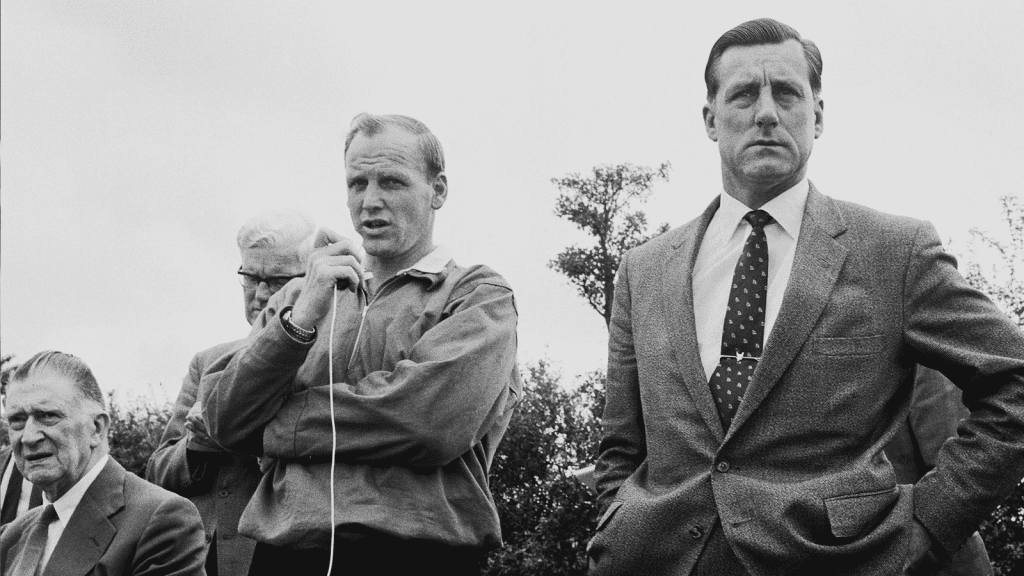
When former Bradford Park Avenue and Brentford defender Ron Greenwood arrived at Highbury as a coach in 1958, it had already been over four years since we had last won a trophy.
Our manager at the time, Jack Crayston, gave him carte blanche to alter the training techniques and tinker with the team, and Greenwood’s impact was quickly noticeable.
We trailed Manchester United 3-0 at half-time in February 1958, before Greenwood reminded his team to put into practice the work they’d completed in training. His players – now delivering pinpoint crosses and ripping down the wings – rallied superbly, narrowly losing 5-4 in the Busby Babes’ last match before the Munich air disaster.
Inspired by the Hungarian side which famously dismantled England 6-3 at Wembley in 1953, Greenwood introduced one and two-touch training sessions, deployed the use of shadow play where players were drilled in the shape and layout of the team, minus the ball, and added “moving triangle’ passing sessions. He even utilised radios and walkie-talkies to vary training techniques. In his first full season at the club, we finished a much-improved third in 1958/59.
In August 1959, George Swindin (who had replaced Crayston as manager the previous year) and Greenwood were interviewed by The Observer, and their comments appeared to usher in a new, forward-thinking era in our tactics. “We’ve got to change or be left behind,” explained Swindin. “We’ve thrown away the defensive concept. To attract the public, the game has got to be entertaining and in football, goals are entertainment.”
Naturally, Greenwood went on to discuss our players’ use of space. “The halves must be the springboard of all your attacks. They must use all the space between them and the forwards so that by moving the ball intelligently, they can dominate the field.” Swindin insisted that we had evolved into “a team of thinkers.”
Greenwood, who also served as England under-23 manager during his time at Highbury, delivered lectures on the use of space on the football pitch throughout the country, but more earthly concerns scuppered his plans in N5. In the 1960/61 campaign, we used 30 players in the League and FA Cup, an unwieldy number. Days after Tottenham completed the 1961 Double, Greenwood departed to West Ham United as manager, and a year later Swindin was dismissed.
Greenwood’s time at Upton Park would see him oversee the development of the 1966 World Cup-winning trio of Bobby Moore, Geoff Hurst and Martin Peters, and the quartet played a major role in them lifting the FA Cup in 1964 and the UEFA Cup Winners’ Cup the following year. After 13 years in east London, he had five years as England manager between 1977 and 1982.
His tactical nous and insistence that his players exploited space on the football pitch to its maximum – ideas which he’d initially formulated at Highbury – ultimately served West Ham United and England phenomenally well in the mid 1960s.
Read more
Liam Brady: Adored in north and east London
Copyright 2026 The Arsenal Football Club Limited. Permission to use quotations from this article is granted subject to appropriate credit being given to www.arsenal.com as the source.